By Fake Review Detector
No single barcode scan can prove a product is authentic. A barcode only identifies the product type — every unit of the same product shares the same code, so a counterfeiter can copy it exactly. To check authenticity, verify the unit's unique serial number or Transparency code through the brand's official channel, match the packaging and seller against the brand's listing, and confirm the warranty covers your country. This guide shows you how, step by step.
Why this check matters in 2026
Counterfeits are not a niche problem. The OECD and EUIPO study "Mapping Global Trade in Fakes 2025" puts global cross-border trade in counterfeit goods at around USD 467 billion — about 2.3% of all world trade in goods (2021 data). For the European Union alone, imports of counterfeit goods were worth around USD 117 billion, about 4.7% of all EU imports. Clothing, footwear and leather goods account for more than 60% of seized counterfeits.
Enforcement is catching more of it, not less. A joint European Commission and EUIPO report published on 22 October 2026 found that EU authorities detained a record 196 million counterfeit items in 2025, with an estimated value of €6.3 billion — 67% more than in 2024. At the EU border alone, detentions rose to more than 42 million items worth almost €2 billion.
And the stakes go beyond a bad handbag. The World Health Organization estimates that at least 1 in 10 medical products in low- and middle-income countries is falsified or substandard (WHO, 2024). Fake medicines, batteries, chargers and car parts can hurt you. That is why a real authenticity check is worth two minutes of your time — before you pay, and again the moment the parcel arrives.
What "authentic" actually means: genuine, grey market, or fake
Three different things get mixed up in listings, and they need three different responses:
- Genuine (authorised channel). Made by the brand or under its licence, sold through an authorised retailer, with the local warranty and after-sales support. This is the safest buy.
- Grey market (parallel import). Also genuine — made by the brand — but imported and sold outside the brand's authorised distribution network. The product itself is real. The problem is what comes with it: often no local warranty, no local support, and sometimes a version made for a different market (different plug, different language manual, different formulation).
- Counterfeit (fake). Made without the brand's permission. It may look convincing, carry a copied barcode and a copied serial number, and still be a fake. The only question that matters here is whether the physical item came from the brand — and no single code check can answer that on its own.
Before you check anything, decide which of the three you are dealing with. A grey-market item is not a scam in the legal sense, but it can still be a bad deal. A counterfeit is a scam, full stop, and your remedy is a refund and a report.
The barcode test: what a barcode can and cannot prove
The barcode on the box is the first thing most shoppers scan — and the most misunderstood check of all.
A standard barcode (UPC or EAN) encodes a GTIN, a product identifier. It tells you which product and which company the number belongs to. It does not identify your individual unit: every single unit of the same product carries the identical barcode. A counterfeiter who copies the packaging copies the barcode with it, and the scan returns the same result as the genuine article.
Here is what each barcode-level check actually tells you:
- Checksum. The last digit of an EAN-13 or UPC-A is a check digit computed from the other digits. A failed checksum means the number was mistyped or made up. A passed checksum only proves the arithmetic is right — it says nothing about the seller or the physical item. For example, the EAN-13 number 3017620422003 passes its checksum; change the last digit to 4 and it fails. That test checks digits, not authenticity.
- Product lookup. Typing the digits into a barcode catalogue tells you which product the number is associated with — brand, model, size, pack count. Compare that with the item in your hand. If the catalogue says "shampoo 250 ml" and you are holding a "perfume 100 ml", the packaging is lying.
- Verified by GS1. GS1's free "Verified by GS1" service shows whether a GTIN is an active number issued by a GS1 member organisation, and which company it belongs to. It does not show that the physical product in your hand belongs to that code — the same GTIN is on every pack.
Use the barcode to gather evidence and compare it with the physical item and the seller. Never treat a successful barcode scan as proof of authenticity. If a seller tells you "scan the barcode, it proves it's real", that claim itself is a red flag.
Serial numbers and IMEI: the check that identifies YOUR unit
Unlike a barcode, a serial number identifies one specific unit. An IMEI does the same for phones and other cellular devices — dial *#06# on the phone to see it. This is the strongest code check available to an ordinary shopper, but it still has limits you must understand.
Where to check, and what you get:
- Apple: enter the serial number at checkcoverage.apple.com, or look under Settings, General, then AppleCare and Warranty on the device. You get the model and the warranty or AppleCare status on record.
- Xiaomi: mi.com/global/verify lets you verify a phone purchase with its IMEI or serial number.
- Samsung and most other electronics brands: the brand's support or warranty page accepts the serial number and shows the model and warranty status it has on record.
- Medicines (Turkey): the İTS system lets you check a medicine by entering the code starting with (01) next to the barcode and the code starting with (21) as the serial number. The result shows the medicine name, manufacturer, production and expiry dates, batch number and registration status. Cosmetics and medical devices go through the ÜTS system, and phones through the IMEI query.
- Watches, sneakers, luxury goods: many brands run their own serial or certificate lookups, or work with authentication services. Check the brand's official website first — never trust a verification link printed on the box alone, because the box can be faked too.
What a serial check can and cannot prove:
- It CAN show whether the number exists in the brand's records, which model it belongs to, and what warranty status the brand has on file.
- It CANNOT show that the unit in your hand is the one the number was issued to. Serial numbers can be copied or reused: one genuine serial can be printed on a hundred fakes. A valid serial also does not prove the item is new, or that the warranty covers your country — a serial registered for a US-market device may carry no warranty in Germany or France.
Practical rules: check the serial soon after buying, while you can still return the item. Never accept a product with a missing or scratched-off serial number — Apple, Samsung and JBL refuse warranty on items like that. And if the serial is not recognised, or shows a different model, stop using the item and contact the seller and the brand while the return window is still open.
QR codes and Amazon Transparency: scan the right way
QR codes sit in the middle: a plain QR code usually just opens a web page, while a serialised QR code — one unique code per unit, backed by a brand database — can retrieve item-level data. The EUIPO's technology guide is direct on this point: QR codes by themselves do not offer protection against copies. The strength of a serial code lies in the record behind it, not in the code itself.
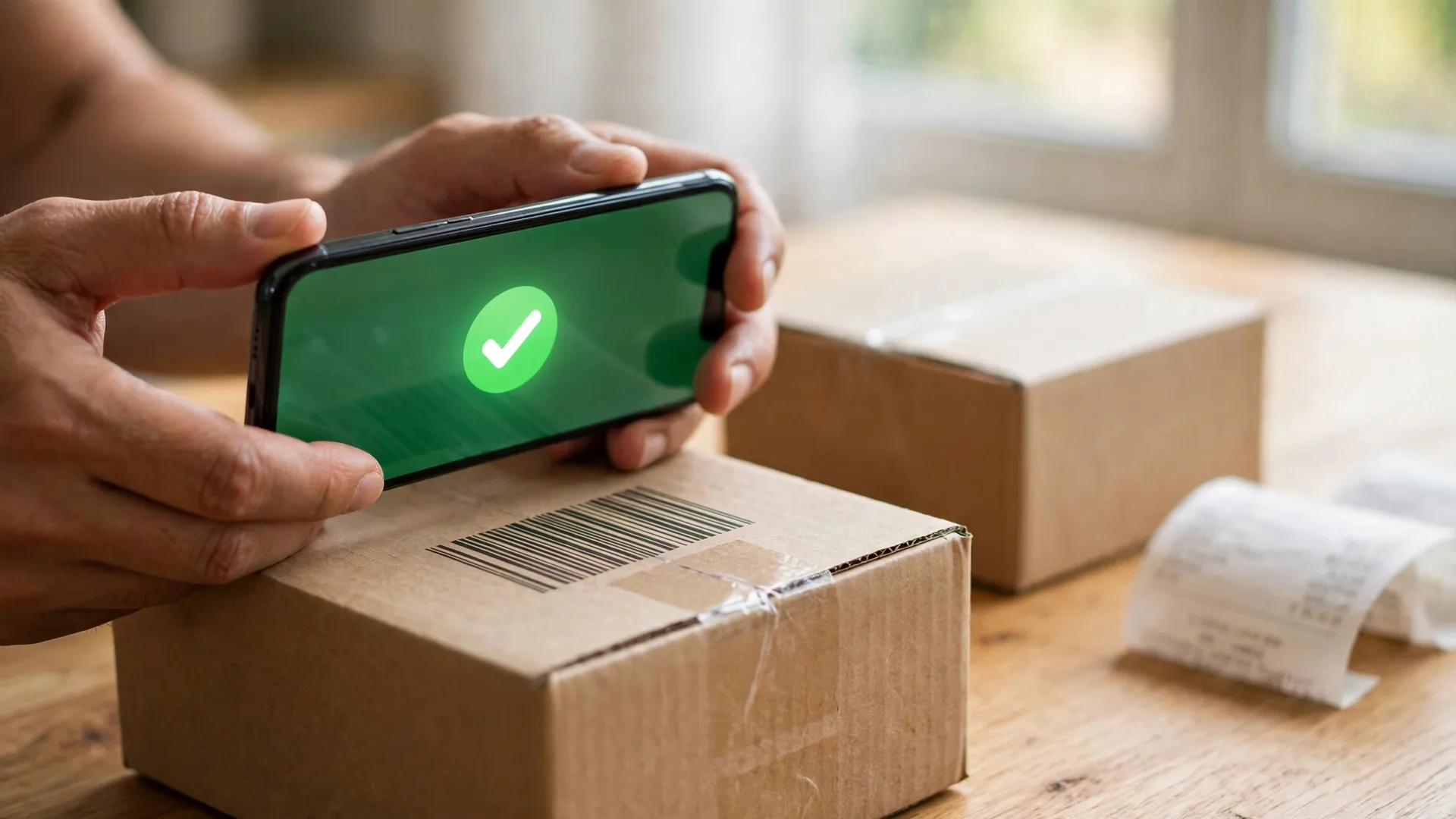
Amazon's Transparency programme is the best-known serialised system shoppers in the US and Europe will actually meet. Each Transparency code is a unique, alphanumeric, non-sequential code printed as a small square barcode on the product packaging. Amazon owns and controls the code-generation protocol and keeps a record of every code generated and the product it belongs to. For products using Amazon-issued codes, you can scan the code with the Amazon Shopping app or the Transparency app: a valid code shows a green check mark, an invalid one shows a red cross. The programme runs in the US, Canada, the UK, France, Italy, Spain, Germany, Japan, Australia and India — and once a product is enrolled, a seller cannot list or ship units without providing a valid Transparency code.
How to scan any QR code safely:
1. Find the brand's method through an official channel first. Check the brand's website or customer service. If an app is needed, confirm the publisher in the app store is the brand itself.
2. Check the address before you open the code. The US Federal Trade Commission warns that scammers can stick their own QR codes over real ones, and advises inspecting the URL for misspellings or switched letters. A code that leads to a lookalike domain is a trap, not a verification.
3. Read the result, then screenshot it. Keep the result screen with its date and time. If the code says "already checked" or "invalid", treat that as a warning sign — the code may have been copied onto many fakes, or may never have existed.
4. Never pay through a QR code. An authentication QR code only queries a registry database. If scanning asks for bank details or a payment confirmation, stop — that is a phishing attempt wearing a product label.
If the brand offers no official verification channel at all, say so honestly: no check exists, and your decision has to rest on the seller, the price and the packaging instead.
The grey market: genuine product, risky purchase
Parallel imports — grey market goods — are genuine products imported into a country without the authorisation of the intellectual-property rights holder, typically through a third-party distributor. They run parallel to the brand's authorised channels. The product is real. The risk is everything around it.
The legal picture depends on where you live:
- European Union: the EU follows regional exhaustion. Once goods are placed on the market within the European Economic Area (EEA) with the rights holder's consent, the rights holder's trademark rights are exhausted across the entire EEA — so a genuine product bought in Spain can be resold in Germany. But rights holders can still block parallel imports coming from outside the EEA. The landmark case is Silhouette International Schmied GmbH v Hartlauer Handelsgesellschaft mbH, which confirmed that regional exhaustion for trademarks does not extend beyond EEA borders.
- United States: the first sale doctrine allows resale of a product after it has been sold by the trademark owner or with their consent. But trademark owners can still act when the imported goods differ materially from the authorised US version — different packaging, different warranty, different contents — in ways that could confuse consumers.
- United Kingdom: post-Brexit, the UK follows its own exhaustion regime. A product first sold in the EEA does not automatically exhaust rights in the UK, and vice versa. Check the specific rules before assuming a parallel import is freely resalable.
For you as a buyer, the grey market trade-off is simple: lower prices and more choice, against weaker protection. Products bought outside the brand's authorised channels are unlikely to be covered by the manufacturer's local warranty, so you may have little recourse if things go wrong. Other grey-market risks include the wrong plug or voltage, a manual in another language, no local safety certification, and a version of the product with different features or ingredients than the one sold in your country.
Before buying a grey-market item, ask three questions: Is the saving big enough to give up the warranty? Is the seller offering their own written warranty instead — and who honours it? And is this a product where a failure would be expensive or dangerous (a phone battery, a car part, a medical device)? If the answer to the last one is yes, buy through the authorised channel.
Packaging and physical tells that still work
No code check replaces looking at the thing itself. Counterfeiters copy codes easily; they copy quality less easily. Check these before the return window closes:
- Spelling and print quality. Blurry text, misspelt words, wrong fonts, crooked labels and cheap-feeling cardboard are classic tells. Compare against photos on the brand's official site, not against another listing.
- Seals and tamper evidence. Broken, missing or re-glued seals; a box that has been opened and resealed; shrink wrap that looks hand-applied. A genuine product from an authorised seller arrives sealed.
- The smell test for cosmetics and perfumes. Off smells, wrong colour, wrong texture, or a formula that separates are strong signs of a fake. Do not use a suspect cosmetic or medicine on your skin while you are checking it.
- Weight, materials and stitching. A fake handbag, watch or pair of trainers usually gives itself away in the hand: lighter materials, uneven stitching, plastic where the real thing uses metal, a clasp that feels wrong.
- What is in the box. Missing accessories, a charger that is not the brand's, a warranty card with no stamp, or a manual in the wrong language all point to a grey-market or counterfeit unit.
- The price. A price far below every authorised retailer is not a bargain — it is the single most reliable warning sign in this whole guide. Counterfeiters compete on price because they cannot compete on quality.
The 60-second authenticity check
Use this routine every time a parcel arrives, before you throw the box away:
1. Match the codes. Do the barcode digits, the serial number and the model number agree across the box, the item itself and the invoice? Any mismatch is a fail.
2. Run the GTIN. Check the barcode number in Verified by GS1. Does the company and product match what you bought?
3. Run the serial. Enter the serial number or IMEI on the brand's official lookup page (Apple's coverage tool, Xiaomi's verify page, or the brand's support site). Does it recognise the number, and does the model match?
4. Scan the QR or Transparency code — through the official app only. A green check is good evidence; a red cross or an "already checked" message is a fail.
5. Check the seller and the listing. Is the seller authorised? Do the listing's reviews look real — or do they read like the same text repeated twenty times? If the reviews look suspicious, paste the review text into our fake review checker and see what it says before you trust the listing.
6. Keep the evidence. Photograph the box, the codes, the invoice and the result screens. If anything fails, you need that evidence for the refund, the chargeback and the report.
If all six steps pass, you have done everything a shopper reasonably can. No check is perfect — a copied serial can pass step 3 — but a product that passes all six is very unlikely to be a fake.
What to do if your product fails the checks
Do not use a suspect product if it could affect your health or safety — a medicine, a battery, a charger, a child-safety product or a car part. Put it aside and act in this order:
1. Contact the seller in writing and state the exact failure: which code, which result, which mismatch. Ask for a full refund. Keep every message.
2. Contact the brand with the serial number, photos and the seller's details. Brands track counterfeit reports and can confirm whether the serial was ever issued.
3. Open a dispute with your payment provider. A chargeback (usually within 120 days) or PayPal protection (180 days) can recover your money when the seller refuses. In the UK, Section 75 of the Consumer Credit Act 1974 covers card purchases from £100 to £30,000, including the full price when you paid only part by card.
4. Report it. In the US, report to the FTC at reportfraud.ftc.gov. In the EU, report to your national consumer authority or customs. In the UK, use Report Fraud (reportfraud.police.uk, 0300 123 2040). In France, forward scam texts and reports to 33700. Reporting helps enforcement seize the next shipment before it reaches another shopper.
5. Leave an honest review — of the seller, not just the product — so the next buyer sees the warning. If the listing's reviews look manipulated, paste the review text into our fake review checker first and let the evidence speak.
You do not need to prove the product is fake beyond doubt to get a refund. A product that fails the brand's own verification, or arrives with a copied serial and a broken seal, is not what you paid for — and the seller, the marketplace and your bank all have processes for exactly that.
Frequently asked questions
Can a barcode prove a product is real?
No. A barcode identifies the product type, not your individual unit — every unit of the same product shares the same barcode, so a counterfeiter can copy it exactly. A barcode lookup or a Verified by GS1 check can confirm which company and product the number belongs to, and a failed checksum shows the number was made up. But a successful barcode scan is not proof of authenticity. Use the barcode to gather evidence, then verify the unit's unique serial number or Transparency code through the brand's official channel.
How do I check a serial number?
Find the serial number on the box, the device itself, or in its settings, then enter it on the brand's official lookup page — for example checkcoverage.apple.com for Apple, or mi.com/global/verify for Xiaomi. A valid result shows the model and the warranty status the brand has on record. Remember that a valid serial only proves the number exists; it does not prove the item in your hand is the one the number was issued to, that it is new, or that the warranty covers your country.
Is a grey market product fake?
No. A grey market (parallel import) product is genuine — made by the brand — but sold outside the brand's authorised distribution network. The product itself is real, but it usually comes without the local warranty or after-sales support, and it may be a version made for a different market. In the EU, regional exhaustion means genuine goods first sold inside the EEA can move freely within it, but brands can block imports from outside the EEA.
What is Amazon Transparency and how do I use it?
Transparency is Amazon's product serialisation service. Each enrolled product carries a unique, non-sequential code on its packaging. If the product uses an Amazon-issued code, scan it with the Amazon Shopping app or the Transparency app: a green check mark means the code is valid, a red cross means it is not. The programme runs in the US, Canada, the UK, France, Italy, Spain, Germany, Japan, Australia and India.
I bought a fake product — can I get my money back?
Usually, yes. Contact the seller first and ask for a refund in writing. If the seller refuses, open a dispute with your payment provider — chargebacks typically run within 120 days, PayPal protection within 180 days. In the UK, Section 75 of the Consumer Credit Act 1974 covers card purchases from £100 to £30,000. Keep the box, the invoice, photos of the codes and screenshots of the verification results as evidence, and report the seller to the FTC, your EU national consumer authority, or UK Report Fraud.
Your next step
The next time a parcel arrives, run the 60-second check before you throw the box away: match the codes, run the GTIN, verify the serial on the brand's official page, scan the QR or Transparency code through the official app, and check the seller. And if the listing's reviews look too good to be true, paste the review text into our fake review checker — a fake product usually arrives with fake reviews attached.
Sources: OECD/EUIPO, "Mapping Global Trade in Fakes 2025" (global fake-goods trade USD 467 billion, 2.3% of world trade; EU counterfeit imports USD 117 billion, 4.7% of EU imports; clothing, footwear and leather goods over 60% of seizures); European Commission and EUIPO, "EU Enforcement of IPRs — Results at the EU border and in the EU internal market 2025" (22 October 2026; 196 million items detained, €6.3 billion); WHO (2024; 1 in 10 medical products in low- and middle-income countries falsified or substandard); GS1, "Verified by GS1"; EUIPO technology guide on QR codes and serialised codes; Amazon Transparency programme pages (sell.amazon.com / sell.amazon.co.uk); US FTC guidance on QR code scams; Harper James and The Law Institute on exhaustion of intellectual property rights and parallel imports.