Is This Text a Scam? The 30-Second Check
By Fake Review Detector
If a text pressures you to click a link, pay a fee, or reply right now — and you were not expecting it — treat it as a scam until proven otherwise. Stop, do not tap the link, and run the 30-second check below. In 2024, Americans reported losing $470 million to scams that started with a text message, five times the 2020 figure (FTC Data Spotlight, 14 April 2025).
The 30-Second Check: 5 Steps Before You Tap Anything
Step 1 — Freeze. Do not tap the link, do not reply, do not call any number in the message. A real delivery company, bank, or government agency will never cancel your parcel, close your account, or fine you because you did not act within minutes.
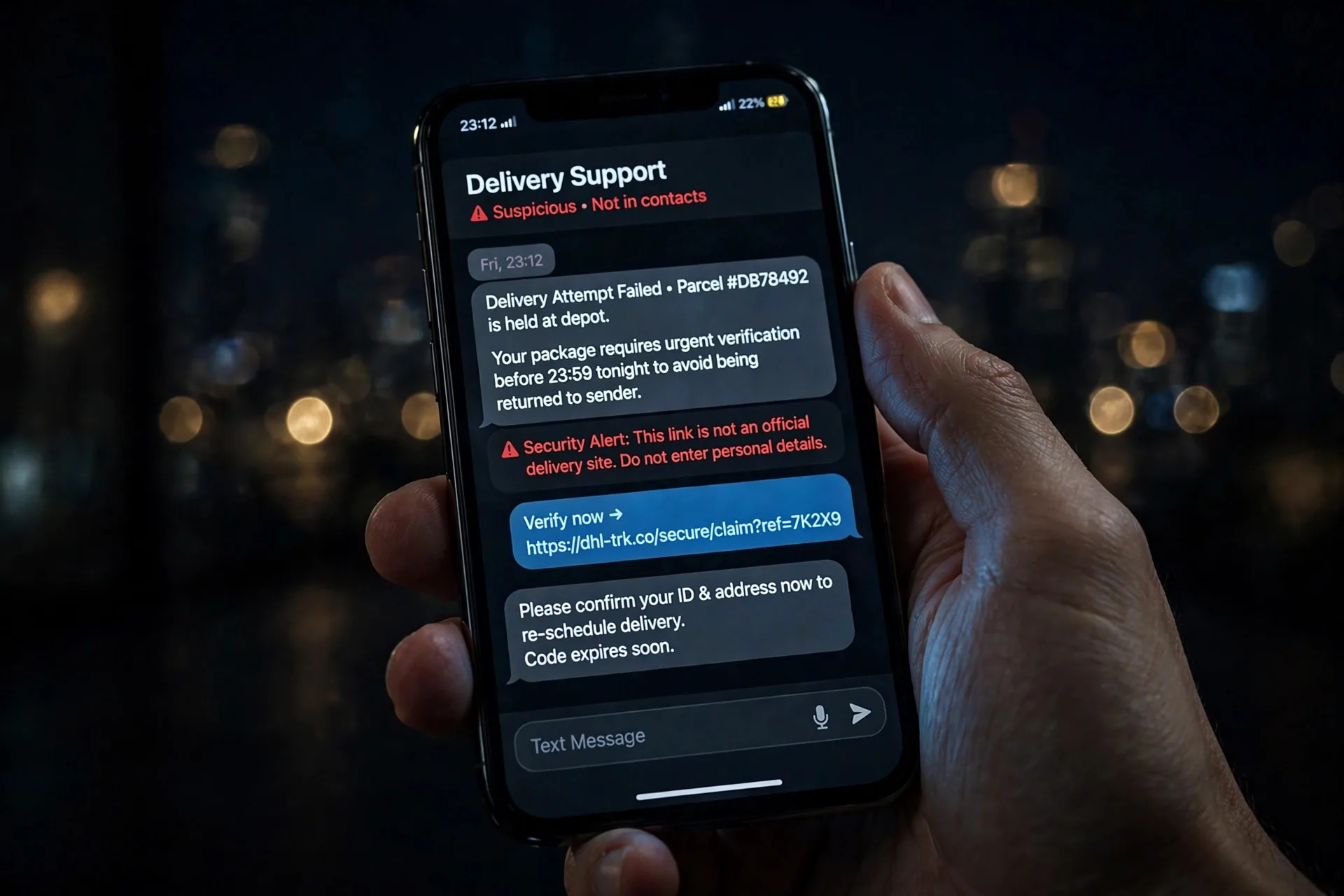
Step 2 — Read the sender. Is it a random mobile number, an email address, or a short code you do not recognise? Real companies text from a consistent sender ID. A "delivery" message from a personal-looking number is a red flag on its own. Also check whether the sender name matches the company — scammers spoof names like "Delivery Support", "USPS", "HMRC", or your bank.
Step 3 — Read the link without tapping it. On most phones, long-press the link to preview the address. Look for misspellings and lookalike domains: dhl-trk.co instead of dhl.com, usps-track.net instead of usps.com, or a random string of letters. A legitimate company links to its own domain, not a shortened or lookalike one.
Step 4 — Ask: was I expecting this? If you have no parcel on the way, no unpaid toll, no tax refund pending, and no account problem, the message is inventing a problem to create urgency. Scammers send millions of these blind — the Bitdefender 2026 Global Scam Intelligence Report (9 June 2026) found that 5.2% of all text messages analysed — roughly 1 in 20 — showed signs of fraud.
Step 5 — Verify through the official channel. Open the company's real app or type its real website address yourself, or call the number on the back of your card. Never use a link or number from the text itself. If the company has no record of the issue, the text was a scam.
If any step fails, the text is a scam. Delete it and report it — the reporting steps are at the end of this guide. If the message also pushes a product review or asks you to post one for money, paste the review text into our fake review checker to see whether the review itself is real.
The 5 Text Scams Hitting Phones Right Now
The FTC found that five schemes made up about half of all text fraud reports in 2024. Learn them once and you will recognise most scam texts instantly.
1. Fake package delivery. "Your parcel is held at the depot. Verify now or it will be returned." This is the most common delivery-text scam in the US and Europe. Real couriers do not ask you to pay a redelivery fee or confirm your address through a text link. Our news post on the billion-message takedown explains how industrial this has become: in October 2026 Microsoft and partners disrupted phishing kits behind more than 1 billion scam emails and texts sent since January 2026 (Microsoft, 14 October 2026).
2. Bogus job offers. "You have been selected for a remote task job — earn $300 a day." These "task scams" ask you to complete small jobs, then demand a deposit to unlock your earnings. Real employers never hire by text and never ask you to pay to get paid. See our guide to the task scam for the full breakdown: /blog/task-scam-fake-review-job-ledger-phishing-2026
3. Fake bank fraud alerts. "Suspicious transaction of $499.99 on your card. Reply YES to confirm or NO to block." Replying connects you to a fake "fraud team" that asks for your card details or a one-time code. Your real bank will never ask for a full password or one-time code by text.
4. Fake toll and unpaid fine texts. "You have an unpaid toll. Pay now to avoid a $50 late fee." These surged across the US and Europe in 2025 and 2026. Toll operators and traffic authorities do not collect fines by text link.
5. The "wrong number" text. "Hi, is this Sarah? Sorry, wrong number — anyway, I'm Emma, I just moved here..." There is no link and no obvious ask. The scammer builds a friendly conversation over days, then introduces a "can't-miss" investment. The FTC's April 2025 report describes this pattern exactly: a simple reply can be the start of a costly investment scam, with victims losing tens of thousands of dollars. The FBI's 2025 Annual Report notes these schemes are largely run by organised criminal enterprises based in Southeast Asia.
7 Red Flags in the Message Itself
Even without knowing the scam type, these seven signs give a text away:
1. Urgency and threats. "Act in 2 hours or your account closes." Urgency is the scammer's favourite tool — it stops you thinking.
2. A link you did not ask for. Especially a shortened link or a domain that is almost — but not quite — the real brand.
3. A request for money, codes, or personal details. No legitimate company asks for passwords, one-time codes, or card numbers by text.
4. Bad spelling or odd grammar. Many scam texts are now polished by AI, so clean grammar no longer proves a text is real — but sloppy grammar still proves it is fake.
5. An unexpected prize, refund, or job. "You won a $500 gift card" or "Your tax refund is ready." If you did not enter, apply, or file, it is not yours.
6. A sender that does not match the brand. A text claiming to be from your bank that arrives from a random mobile number.
7. A demand to keep it secret. "Do not tell anyone — this is a confidential investigation." Real organisations never say this.
Two or more red flags together mean: do not engage.
The Sender Check: What the Number Really Tells You
A phone number tells you almost nothing about who sent the text. Scammers spoof sender IDs so a message can appear to come from a short code, a brand name, or even a number in your contacts. A message that says "Not in contacts" or arrives from an unknown number while claiming to be your bank is already suspect.
What actually helps: search the exact wording of the message in your browser. Scam texts are sent to millions of people, so the same wording usually appears in scam warnings within minutes. Also check whether the brand has a verified sender — in Australia, for example, the regulator ACMA runs an SMS Sender ID Register, and messages from unregistered IDs are labelled "Unverified" (launched 1 July 2026). In the US and UK there is no universal verified-sender label yet, which is exactly why the 30-second check matters more than the sender name.
The Link Check: Never Tap, Always Verify
A link in a text is the most dangerous part. One tap can open a fake login page that steals your password, or download malware. The rule is simple: never tap a link in an unexpected text.
Instead, long-press the link to preview the destination, or copy it and inspect it. Real company domains are short and exact: amazon.com, dhl.com, usps.com, gov.uk. Scam domains add words, swap letters, or use a different ending: amazon-support.net, dhl-track.co, usps-delivery-claim.com. URL shorteners hide the destination entirely — treat any shortened link in an unexpected text as a scam.
If you genuinely need to check a delivery or account, open the company's official app or type the address yourself. That single habit defeats almost every link-based text scam. If you want to check whether a website a text points to is safe, paste the address into our free website checker: /website-checker
The "Wrong Number" Trap: The Scam With No Link at All
The most dangerous scam text in 2026 may be the one with no link, no threat, and no ask. It starts with a friendly wrong-number message, builds a conversation over days or weeks, and ends with an investment "opportunity" on a fake trading platform. McAfee's 2026 State of the Scamiverse report says the average American now receives 14 scam messages a day across texts, email, and social media — and a growing share of them are these slow, linkless conversations.
The defence is the same as for any other text: do not reply to a stranger's wrong-number message. A polite "wrong number" reply is exactly the opening the scammer needs — it confirms your number is live and that you answer strangers. Block the number, report it as spam in your messaging app, and move on.
What to Do If You Already Replied or Clicked
Do not panic — act fast, in this order:
1. If you entered a password, change it immediately from the real website or app, and change it anywhere else you reused it.
2. If you entered card details, call your bank now and ask them to block the card. In the UK, Section 75 and chargeback rules may help you recover a payment — our comparison guide explains the routes: /blog/chargeback-vs-section-75-vs-paypal-protection-2026
3. If you sent money, contact your bank and report it to the police — and see our recovery steps: /blog/paid-a-scam-website-9-steps-to-take
4. If you downloaded an app or file, delete it and run a security scan.
5. If the scammer has your personal details, consider a credit freeze or fraud alert with your credit bureau.
6. Save the message as evidence — screenshot it before you delete it.
How to Report a Scam Text (US, UK, and EU)
Reporting takes under a minute and it is how these networks get shut down. Every report feeds the databases that carriers and investigators use to block the next wave.
- United States: forward the text to 7726 (it spells SPAM) — your carrier uses it to block similar messages. Then report it at ReportFraud.ftc.gov. If money was lost, also report to the FBI at ic3.gov.
- United Kingdom: forward the text to 7726 (free, all major networks). If you lost money or were targeted by fraud, report to Report Fraud at reportfraud.police.uk or 0300 123 2040. Report Fraud replaced Action Fraud on 4 December 2025.
- France: forward the text to 33700, the free national reporting number.
- European Union: report through your national consumer protection authority, and forward the text to your carrier's spam number.
The FTC told Congress in March 2026 that a text message was the top contact method in fraud reports for 2025 — a year with 3 million fraud reports and $15.9 billion in reported losses. Your report is what turns one scam text into a pattern investigators can act on.
Check Any Suspicious Text Free
If you are still unsure about a message, do not guess. Copy the text and paste it into our free scam text checker, which analyses the wording, sender, and link for scam signals: /scam-text-checker
And if the text was a review-related scam — a fake review, a paid-review offer, or a message asking you to post a review for money — paste the review text into our fake review checker to see whether the review itself is genuine.
Frequently Asked Questions
Q: Is this text a scam if it comes from a number I recognise?
A: Not necessarily — but do not trust the number alone. Scammers spoof sender IDs, so a message can appear to come from a brand, a short code, or even a contact. Judge the message by its content: unexpected urgency, a link, or a request for money or codes means scam, whatever the sender says.
Q: Should I reply STOP to a scam text?
A: No. Replying — even with STOP — confirms your number is active and can invite more messages. The safest move is to report the text in your messaging app, forward it to 7726, then block the sender and delete the conversation.
Q: Can a scam text infect my phone if I only open it?
A: Opening a text message alone is very unlikely to infect a modern phone. The danger is in tapping the link or downloading an attachment. If you only opened the message, delete it and move on; if you tapped a link or downloaded something, run a security scan and change any passwords you entered.
Q: What is smishing?
A: Smishing is SMS phishing — a scam carried out by text message instead of email. The name combines "SMS" and "phishing". It covers fake delivery texts, bank alerts, toll scams, and wrong-number investment traps. The 30-second check in this guide works for all of them.
Q: I got a delivery text but I am expecting a parcel. Is it real?
A: It might be — but verify it through the official channel, never the link in the text. Open the courier's app or type its real website yourself and check the tracking number there. If the tracking number in the text does not match your real order, the text is a scam using a guessed delivery.
Your Next Step
The next suspicious text you receive, run the 30-second check before you tap anything: freeze, read the sender, inspect the link without tapping, ask whether you expected it, and verify through the official channel. Then forward it to 7726 and delete it. If a text ever asks you to write or post a review for cash, paste the review text into our fake review checker first. If you want a second opinion on any message, paste the text into our free scam text checker: /scam-text-checker — it takes seconds, and it is free.