By Fake Review Detector
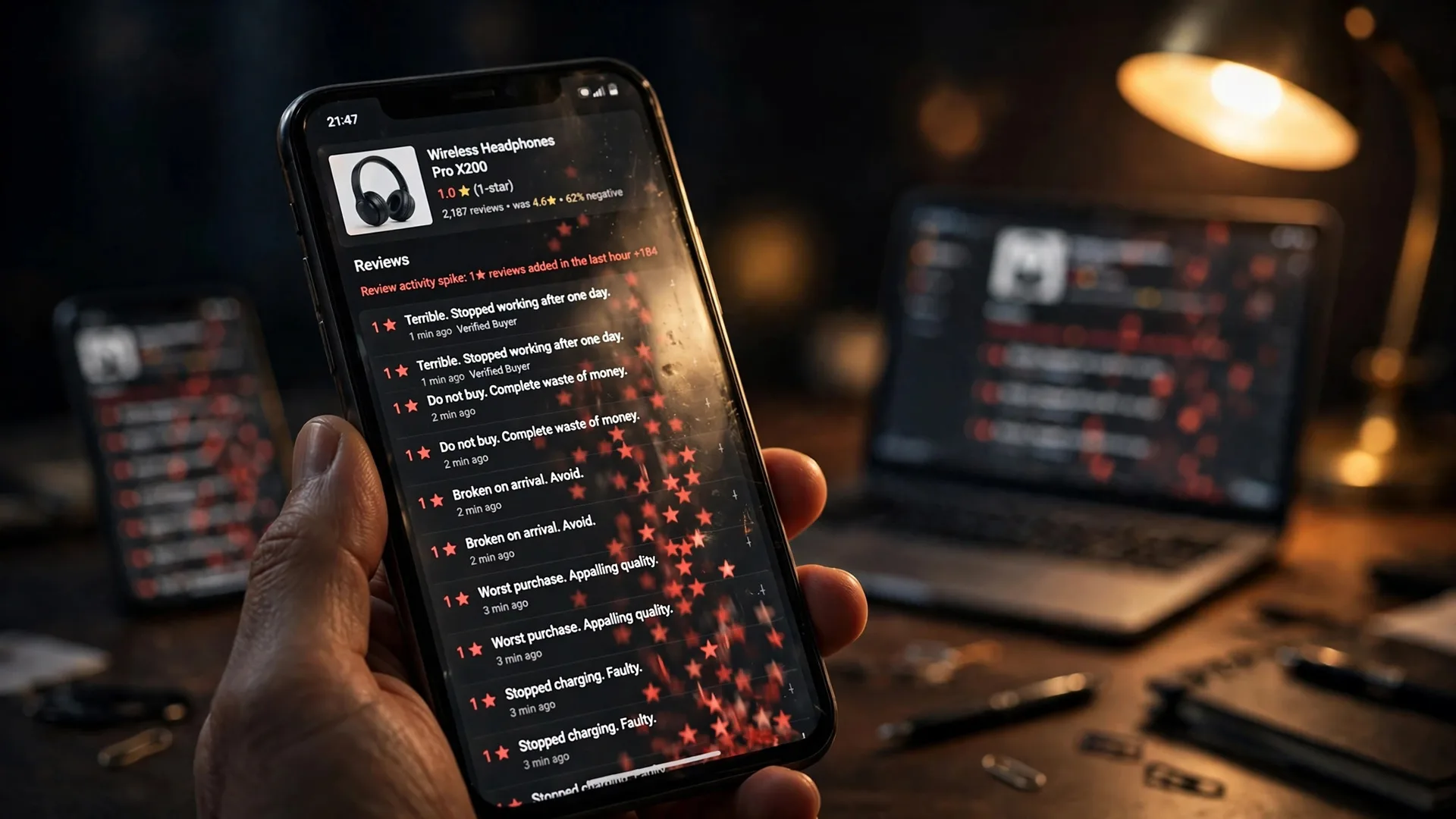
Review bombing is a coordinated flood of negative reviews — usually 1-star ratings posted in a short burst by people who often never used the product — designed to drag a rating down and punish a business, game, film, or creator. It is not honest criticism. It is a campaign, and once you know the signs, you can spot one in about a minute.
A single bad review is feedback. A thousand bad reviews in one afternoon is an attack. Review bombing works because most shoppers never look past the star average: a product that was 4.6 stars on Monday can read as a 1.0-star disaster by Tuesday, and the sales damage happens before anyone checks whether the reviews are real. This guide explains what review bombing is, why people do it, the most famous cases, how platforms fight it, and the quick check you can run before you let a bombed rating decide what you buy.
What Is Review Bombing?
Review bombing happens when a group of people coordinates — on a forum, a Discord server, a subreddit, or social media — to post a wave of negative reviews about the same product, business, game, or film at the same time. The goal is not to warn other shoppers. The goal is to move the number: push the average rating down, trigger platform warnings, and cost the target sales, visibility, or reputation.
A review bomb has three ingredients. First, coordination: the reviews arrive together, often within hours, after a call to action somewhere online. Second, volume: dozens, hundreds, or thousands of reviews, far more than the product would normally receive in that window. Third, motive unrelated to the product itself: the reviewers are angry about a price change, a story decision, a political statement, a ban, or a business decision — not about the quality of what they bought.
Review bombing is not limited to 1-star attacks. The same tactic runs in reverse: "counter-bombing" floods a target with 5-star reviews to cancel out the attack. Both distort the rating, and both make the star average useless as a guide to quality. The academic research on the most famous case — The Last of Us Part II on Metacritic, studied in a 2024 paper in the journal Quality & Quantity — found exactly this pattern: an ideology-driven negative bombing followed by a grassroots positive counter-bombing, with neither side writing about the game itself.
Review Bombing vs. Genuine Bad Reviews: How to Tell the Difference
A genuinely bad product earns bad reviews slowly, over weeks and months, from buyers who describe specific problems. A review bomb arrives all at once. That timing gap is the single most reliable clue, and it is the first thing to check.
Genuine negative reviews talk about the product. They mention the battery dying after a week, the zipper breaking, the delivery arriving late, the size running small. Bomb reviews talk about something else: a company policy, a CEO's tweet, a character in a game, a price increase, a political position. If the complaints are about the company and not the product, you are probably looking at a bomb.
Genuine reviewers have history. Their accounts show past reviews, varied ratings, and normal language. Bomb reviewers often have brand-new accounts, a single review to their name, or a profile full of identical 1-star ratings posted on the same day. Copy-paste wording is another giveaway: when twenty reviews use the same unusual phrase, they were written from the same script.
Finally, genuine bad reviews spread across the rating scale — some 1-star, some 2-star, some 3-star — because real people disagree. A review bomb is a spike: a sudden wall of 1-star ratings that looks nothing like the product's normal rating distribution. Check the rating histogram if the platform shows one. A healthy product has a curve; a bombed product has a cliff.
Why Do People Review Bomb?
People review bomb because it works — and because it is cheap, anonymous, and fast. Posting a review costs nothing, takes a minute, and can do real financial damage to a business that depends on its star rating. The motives fall into a few familiar patterns.
The most common motive is protest. Gamers bomb a game over a pricing change, a delayed feature, or a story choice they hate. Film fans bomb a movie over casting. Customers bomb a restaurant or shop over a viral incident. The review section becomes the protest placard because it is the most visible place to hurt the target.
The second motive is rivalry. A competing business — or someone paid by one — can commission a flood of fake 1-star reviews to push a rival down the search results. This is not protest; it is sabotage, and it is illegal in several jurisdictions. The US Federal Trade Commission's fake review rule, which took effect on October 21, 2024, bans buying or selling reviews conditioned on a particular sentiment, including paid negative reviews aimed at a competitor.
The third motive is ideology and culture wars. The biggest review bombs in history were not about product quality at all. They were about politics, representation, and identity — coordinated on forums and aimed at a game, film, or book because of what it represents rather than what it is. And the fourth motive is simple trolling: some bombs exist because a group found it funny to watch a rating collapse in real time.
Whatever the motive, the effect on shoppers is the same. The rating stops telling you whether the product is good, and starts telling you whether somebody is angry.
Famous Review Bombing Cases
The Last of Us Part II is the textbook case. Released on June 19, 2020, the game earned a 94/100 average from professional critics on Metacritic — then its user score collapsed to 3.3 out of 10 from more than 16,000 user reviews in the first 24 hours, many posted by people who had not played it, reacting to leaked story details. The score later settled around 5.5 to 5.7 as more than 127,000 reviews accumulated, but the damage to the launch conversation was already done. Metacritic responded by adding a 36-hour waiting period before user reviews open on new games, so players must have time to actually play before rating.
Steam faced the problem earlier and built one of the best defences. In 2017, after repeated review bombs on games, Steam added a review histogram showing exactly when reviews spiked, and began flagging "off-topic review activity" periods. When a bomb is detected, the reviews from that period are excluded from the game's overall review score, while still remaining visible for anyone who wants to read them. It is the model other platforms are still catching up to.
Warcraft III: Reforged became the lowest user-rated game in Metacritic history after its 2020 launch, when players bombed it over missing features and broken promises — a case where the anger was at least partly about the product, which is why the distinction between a bomb and a genuine backlash matters. And on the film side, review bombing of audience scores became so routine that Rotten Tomatoes removed its "want to see" percentage in 2019 after coordinated campaigns targeted films before release.
Review bombing is not a gaming-only problem. Google Business Profiles, Amazon listings, Trustpilot pages, and TripAdvisor listings for hotels and restaurants are all bombed regularly — sometimes by angry customers, sometimes by competitors, sometimes by coordinated groups. A small business with forty reviews can be destroyed by a single weekend of fake 1-star ratings.
How Review Bombing Hurts Shoppers and Honest Businesses
For shoppers, the harm is simple: you get lied to. You skip a good product because its rating was bombed, or you buy a bad one because a counter-bomb inflated it. Either way, the review system fails at its one job — telling you what real buyers thought.
For businesses, the harm is financial and fast. On Amazon, a rating drop from 4.5 to 3.5 can cut conversion sharply, because shoppers filter by star rating and never see the listing at all. On Google, a flood of 1-star reviews pushes a local business down the map results and scares off customers who never read a word. For a small shop, a restaurant, or an independent seller, a review bomb can mean weeks of lost income over something they did not do — or over a product fault that was real but wildly exaggerated by the pile-on.
There is a second, quieter harm: review bombing teaches shoppers to distrust all reviews. When people learn that ratings can be gamed, they stop trusting the honest ones too. That is why platforms, regulators, and reviewers all have a stake in stopping it.
How Platforms Fight Back
Steam's approach — show the spike on a histogram, exclude bomb periods from the score — remains the gold standard, because it keeps the reviews visible while stopping them from moving the number. Metacritic's 36-hour delay on new game reviews removes the launch-day pile-on window. Google lets businesses flag reviews that violate its policies and removes fake reviews in bulk when it detects coordinated abuse, though its process is slow and businesses often wait weeks.
Trustpilot and TripAdvisor run detection systems that look for the same signals this guide teaches you to spot: review velocity, new accounts, duplicate text, and reviewers with no history. They also allow businesses to report suspected fake reviews, and both platforms remove reviews that break their rules — although neither is perfect, and genuine reviews sometimes get caught in the net.
The law is catching up too. The FTC's Consumer Review Rule (16 CFR Part 465), effective October 21, 2024, bans creating, buying, selling, or spreading fake reviews — including AI-generated ones — and bans paying for reviews conditioned on a particular sentiment, positive or negative. Violations can carry civil penalties reported at up to about $53,088 per violation. In Europe, the EU Digital Services Act requires large online platforms to provide a way to report illegal content and act on reports, and EU consumer law has long banned fake reviews as a misleading commercial practice. The rules exist. Enforcement is still catching up to the scale of the problem.
How to Spot a Review Bomb Before You Trust the Rating
Run this 60-second check before you let a star average decide a purchase.
First, look at the rating histogram or review timeline. A normal product has reviews spread over months. A bombed product has a sudden vertical spike — hundreds of reviews in a day or two, then silence. If the platform shows a graph, the bomb is visible at a glance.
Second, sort by most recent and read ten reviews. If they all say the same thing in the same words, or all complain about the company rather than the product, be suspicious. Real buyers write differently from each other.
Third, click three reviewer profiles. If they were created this week, have one review each, or have only ever posted 1-star ratings, the "consensus" is manufactured. A reviewer with a long history of varied ratings is worth ten brand-new accounts.
Fourth, compare platforms. A product bombed on Amazon may have a normal rating on the brand's own site, on Trustpilot, or on Google. If one platform shows a 1.2 average and three others show 4.4, the outlier is the bomb, not the truth.
Fifth, check the dates against the news. If the review spike lines up with a controversy, a price change, a viral video, or a launch — rather than with anything about the product itself — you are reading a protest, not a product verdict.
And when the reviews themselves are the evidence, test them directly: paste the review text into our fake review checker (https://fakereviewdetector.org/fake-review-checker) and let it analyse the wording, the patterns, and the signals that separate a real buyer's complaint from a coordinated script. A single suspicious review is worth checking; a whole page of them is worth checking before you spend a dollar or a euro.
What to Do If Your Business Gets Review Bombed
If you run a business and the 1-star reviews arrive in a flood, do not panic and do not respond in anger. Document everything first: screenshot the review spike, note the dates and the identical wording, and save links to the forum or social media post that called for the attack. Evidence is what platforms and regulators ask for.
Report the reviews through the platform's own process — Google Business Profile, Amazon, Trustpilot, and TripAdvisor all have reporting routes for fake or policy-violating reviews — and report them in batches with a short, factual explanation: coordinated timing, duplicate text, reviewers with no purchase history. Flagging one review at a time is slow; a clear pattern report gets faster action.
Respond publicly to a few of the reviews, calmly and factually, for the benefit of the shoppers reading them. A short reply — "We have no record of this order; please contact us so we can verify" — tells real customers that something is off, without feeding the attackers.
Do not fight back by buying positive reviews. That is the same offence in reverse, it is banned by the FTC rule, and platforms will penalise you for it. Instead, ask your real customers to share honest reviews. A steady flow of genuine reviews is the only lasting defence: it dilutes the bomb, restores the average, and rebuilds the rating on real experience.
Frequently Asked Questions
Is review bombing illegal? Posting an honest negative review is legal everywhere. But paying for fake negative reviews, or coordinating fake reviews to damage a competitor, can break the law. In the US, the FTC's Consumer Review Rule (effective October 21, 2024) bans buying or selling reviews conditioned on a particular sentiment, and in the EU, fake reviews are banned as a misleading commercial practice. A genuine protest review and a paid fake review are very different things in the eyes of the law.
What is the difference between review bombing and a genuine backlash? A genuine backlash grows over time from real customers describing real problems with the product. A review bomb arrives in a sudden spike, often from people who never bought the product, complaining about the company, a policy, or a controversy rather than the product itself. Check the timing, the wording, and the reviewers' history — the three together usually settle it.
Can a review bombed rating recover? Yes. Platforms like Steam exclude bomb periods from the score, Metacritic's delay blunts launch-day attacks, and Google removes fake reviews when businesses report them with evidence. A steady flow of genuine reviews after the attack also pulls the average back. Recovery takes weeks, not days, and it is faster when the business reports the attack with documentation.
Does Amazon remove review bombed reviews? Amazon removes reviews that violate its policies, including fake reviews and reviews from people who never bought the product, and it has sued review brokers in the US and Europe. But detection is not instant, and sellers often need to report suspicious reviews and provide evidence before Amazon acts. Shoppers should never trust a single platform's average during a visible spike.
How can I tell if a product's reviews are real before I buy? Check the rating histogram for sudden spikes, read the most recent ten reviews for copy-paste wording, click a few reviewer profiles to see if they are new or single-review accounts, and compare the rating across two or three platforms. Then paste the review text into our fake review checker for a direct analysis of the wording and patterns before you spend your money.
Your Next Step
A star rating is only as honest as the reviews behind it. The next time a product shows a suspicious 1.0 average — or a suspiciously perfect 5.0 — run the 60-second check in this guide: look at the timeline, read ten recent reviews, check three profiles, and compare across platforms. And when a review reads like a script rather than a shopper, paste the review text into our fake review checker and get a verdict before you trust it. The bomb only works if you believe the number without looking behind it — so look behind it, every time.
Related reading: https://fakereviewdetector.org/blog/how-to-spot-fake-reviews-2026 https://fakereviewdetector.org/blog/the-4-signals-of-a-fake-review-2026 https://fakereviewdetector.org/blog/fake-reviews-statistics-2026
Explore the evidence behind your next question.
Start a website check